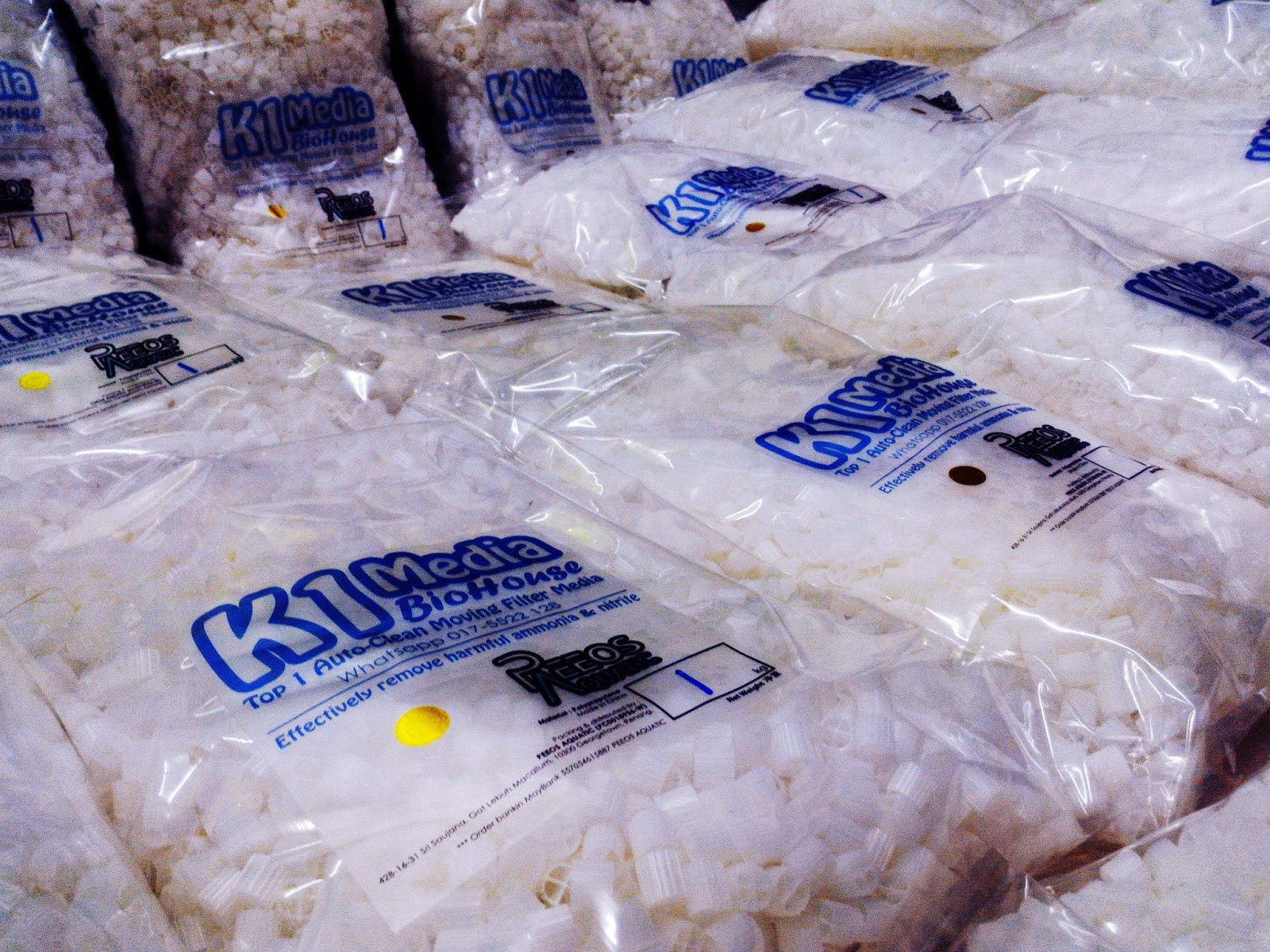
✓ Diameter x Height 10mm.
✓ Each 5kg handling 250g daily food.
✓ Auto cleaning - No Maintainance require.
✓ 100% PREMIUM QUALITY Polypropylene.
✓ Freshwater• Aquaculture • Saltwater • Ponds • Aquarium use.
✓ Actively removes harmful ammonia and nitrite from the water.
✓ Developing eco-system for bacteria involved in nitrification process.
✓ Maximum bacteria colonise surface per area more than other types of static media.
-----------* PROMOTION *-----------
8kg = RM520.00
Free Pos Semenanjung only
16kg = RM1040.00
Free Pos Sabah Sarawak only
Whatsapp +60175522128
---------------Whatsapp Promotion Code K1B8FPNSB16FSSBSAPR17 ke 0175522128 ------------
HOW TO: Build an aquarium sump - fluidized moving bed filter
Now Available for Malaysian
DIY K1 with 2 Liter
---------- !!!沉水固定型滤材的烦恼 !!! ----------
Masalah static media / Static Media Problem
任何滤材只要有水流不顺畅的地方就无法带给微生物需要的足够食物(氧气, ammonia和 nitrite), 就会造成系统发展缓慢甚至缺乏食物而死亡,处理效果更是大打则扣严重受影响。 Sekiranya terdapat tempat pengaliran air tidak lancar, tempat tulah tidak dapat membawa makanan ( oksigen, ammonia dan nitrite) secukupnya kepada koloni bakteria akibatnya system nitrifying tidak berkembang dan koloni mati kebuluran. Fungsi system tentu tidak berkesan.
造成水流不顺的原因有:
PUNCA PENGALIRAN AIR TIDAK LANCAR:
养菌孔被阻塞(用一段时间后),有固定的水流死角
Lubang pada media tersumbat, mempunyai air "Death Spot"
-------------------- ****** --------------------
Kaldnes Biohouse K1 filter media bergerak memelihara koloni bakteria sama ada yang suka oksigen atau tidak. Untuk tujuan menghilang toxic buangan ikan ( ammonia ), K1 biasa diguna mumupuk bakteria system suka oksigen iaitu nitrosomonas dan nitrobacter dalam proses nitrifying. Perbezaan media bergerak berbanding dengan media static dalam kuantiti yang sama : ✓ media bergerak lebih luas permukaan tinggal koloni bakteria ✓ media bergerak lebih banyak koloni bakteria ✓ media bergerak lebih banyak bakteria muda yang aktif ✓ media bergerak boleh proses hasil buangan makanan ikan sebnyak 0.5kg untuk setiap 100 liter media ✓ media bergerak membolehkan air melalui setiap media dengan seimbang ✓ media bergerak menyampaikan makanan seimbang (oksigen dan ammonia) ke setiap nitro bakteria di semua permukaan media ✓ media bergerak lebih berkesan menghilangkan ammonia ✓ media bergerak senang setup ✓ media bergerak tidak perlu penjagaan rapi ✓ media bergerak boleh bersihkan sendiri, tidak lagi perlu selalu cuci atau tukar ✓ media bergerak tidak ada kawasan tersumbat atau air tidak melaluinya.
How Kaldnes K1 BioHouse different from other static Filter media ? How it works? Maturing the K1 Media bio-media is important because a delicate eco-system is naturally developing for the bacteria involved in the nitrification process. K1 Media provides the maximum active surface area for the bacteria to colonise, more than other types of static media. It is this process which removes harmful ammonia and nitrite from the water. How it is different to other media? As the K1 Media moves within the filter, it causes the old dead bacteria on the outside to be displaced. This makes space for new younger heavier feeding bacteria to rapidly colonise. Within the wheel is a protected surface which enables colonies of bacteria to naturally follow their lifecycle, of maturing, dying and then fueling the latter stages of the nitrification cycle. K1 Media has been designed to provide the best possible habitat for both young and mature beneficial bacterial colonies.
Koi Pond Upgrade to Kaldnes K1
What is meant by 'self cleaning'? Unlike foam, matting, or other forms of static filtration media, the K1 Media is designed to move freely within your filter. The constant chaotic movement of the air from your pump, causes the media to self clean and thus requires no maintenance. This allows the filter to reach optimum effectiveness without the disturbance of periodic cleaning, avoiding unnecessary loss of bacteria within the filter. 50 Litres of K1 media will handle up to 250 grammes of food per day
---------------------------------------新手常见问题--------------------------------------- People who began using K1 BioHouse in Aquarium filters have reported a few details which deserve repeating
Q1 First, when the media is new, it tends to be a little more buoyant than you would like it to be. A layer of floating media several feet thick, may extend above the surface of the water several inches. 新的滤材比想象中的轻浮,无法转动。漂浮的滤材可能有几尺高甚至会露出水面几寸。 A1. When mature, the media will not rise above the surface. 当滤材成熟时它们不会浮出水面。 Q2: The extra buoyancy will make it very difficult to get it to “roll” when aerated. 轻浮的特性根本让它们无法转动 A2. The extra buoyancy may be the result of waxy release agents used in the manufacturing process. To speed up the process of maturing, you can treat the media with one gram of potassium permanganate per three gallons of water. Of course, you would not want to expose the pond water or the fish to the potassium permanganate unnecessarily. The potassium permanganate treatment seems to speed up colonization by the nitrifying bacteria as well. 多余的浮力很可能是滤材在释放制作过程当中使用的糯原料。每11.3L水添加1g的potassium permanganate可以加快建立硝化菌系统。但是您当然不想鱼虾暴露在potassium permanganate里。 Q3 Thirdly, when new media is put into service, the color will turn from white to brown as the bacteria colonize the surface. After a month or so, and after the filter is “cycled” and performing well, the media will turn from brown to a light beige color. It is thought that the bacterial biofilm becomes so thick that the Outter layer sloughs off. 当菌体开始居住时滤材的颜色逐渐从白色转变成褐色。1个月左右或者滤材很好地运作,滤材本身的颜色反而会从深褐色逐渐转为浅褐色,预期应该是细菌膜不断在增加变厚值到外层全被菌膜覆盖。 A3: Even though the thickness of the biofilm is reduced and the color changes, the media continues to perform as before and there is no increase in ammonia or other change in water quality. Ammonia和水质在这个时候已经没有改变(稳定),细菌膜的厚度自然减少还有滤材颜色变浅,但是滤材本身还是一样很正常的在运转。
Q4.All media shed biofilm as it grows and becomes too thick to be held in place on the surface of the media. Some types of media and systems shed bacteria biofilm mainly in the cleaning process. 任何所有有细菌膜的滤材最终变成太厚以至于无法正常运作,有的细菌膜滤材和系统只专注在净水功能。 A4. K1 BioHouse is essentially self cleaning and continuously cleaning. However, this means that shed biofilm is carried with the water back to the pond to the next stage in the filtration process. All biofilters should be located after the mechanical filter (if one is used) to minimize the amount of debris which could become trapped and smother the biofilm. K1生物屋是建立在自己持续物理清理的基础之上,但是它受保护的内部细菌膜是会被带回水里继续下一阶段的硝化过程。任何所有的生物过滤系统在使用一段时间后都必须更换以减少可能的水流死区,让生物过滤系统更加顺畅。 Q5 Thirdly, some feel that Matala mat (Japanese mat) is more “resilient” than K1 BioHouse filter media. 觉得化生棉比K1滤材有更加菌体居住。 A5: K1 BioHouse can handle a higher feed rate per unit area when the feed rate and other conditions are stable. However, if the feed rate is increased abruptly, the bacteria population in Matala mat will quickly adjust to the larger amount of ammonia. The bacteria population in K1 BioHouse takes longer to adjust. This could be the result of the Matala mat maintaining a thicker layer of biofilm. Matala can also be operated with air bubbles moving up through the media. This will provide oxygen, but does not significantly clean it. K1 BioHouse and the moving bed biological filter is an interesting concept and easy to use. 比较相同的面积的不同滤材,当其他因素稳定时,K1生物屋可以处理更多的喂食量。但是,如果喂食平衡量突然被增加时,日本生化棉的菌群确实可以更快地调整来处理大量的Ammonia; K1的菌群则需要多一点的时间来做这个调整,这会造成生化棉的细菌膜增加更厚。生化棉确实也可以考打气来培养菌群,这样可以增加氧气量但是生化棉无法进行自己清理;